

On this page
- What is accounts receivable in healthcare?
- A/R aging buckets explained
- How to read an aging report
- Why A/R gets old
- Insurance follow-up workflow
- Old unpaid claim recovery
- Step 1: Recoverability triage
- Step 2: Reconstruct the history
- Step 3: Choose the route
- Step 4: Set honest expectations
- How to prioritize A/R work
- Patient balances
- Before billing the patient
- Patient collection workflow
- Mednex and practice responsibilities
- Records and access needed
- How A/R progress is measured
- Quality checks and exceptions
- A/R recovery and prevention
- Next steps
What is accounts receivable in healthcare?
Accounts receivable (A/R) is the total of all balances owed to a practice for services already delivered. In a medical office, it has two parts: insurance A/R, which is money owed by payers on submitted claims, and patient A/R, which is money owed by patients after insurance has paid or when no insurance applies.
A/R is not a sign of failure. Every practice that bills insurance carries some, because payers take time to process claims. The concern is how old the balances are and whether anyone is actively working them. A claim that is 20 days old is normal. A claim that is 150 days old and has had no follow-up is probably in trouble.
The search terms “accounts receivable in healthcare,” “AR follow up in medical billing,” and “account receivable management services” all describe this work. It sits inside the larger revenue cycle, and it overlaps with denial management. The difference: denial management focuses on claims the payer has decided not to pay, while A/R recovery covers every open balance, including claims with no response at all.
A/R aging buckets explained
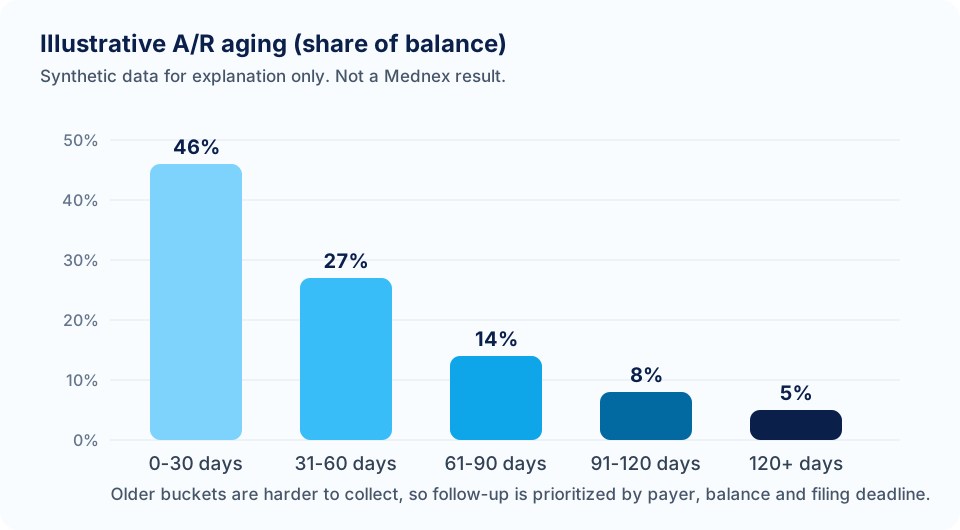
An A/R aging report groups open balances by how long they have been outstanding. Most practice management systems produce one, and it is the main tool for A/R work. The standard buckets are:
| Bucket | Meaning | What it usually contains | Typical action |
|---|---|---|---|
| 0 to 30 days | Recently billed | Claims in normal payer processing, some not yet received | Confirm receipt; no heavy follow-up needed yet |
| 31 to 60 days | Past normal turnaround for many payers | Slow payers, claims needing information, early denials | Check claim status; read any denials |
| 61 to 90 days | Needs attention | Unanswered claims, unworked denials, misrouted claims | Active follow-up with the payer; correct and resubmit where needed |
| 91 to 120 days | At risk | Stalled or lost claims, appeals in progress | Escalate; confirm deadlines |
| Over 120 days | High risk | Timely filing exposure, abandoned denials, coverage problems | Triage for recoverability; document write-off decisions |
The line between a normal and a worrying age depends on the payer, the claim type, and the payer’s own processing times. Some practices use a different bucket structure, such as 0 to 30, 31 to 60, 61 to 90, and 90 plus. What matters is that the report is consistent from month to month.
How to read an aging report
- Look at the shape, not just the total. A report with most dollars in the first two buckets looks different from one with a heavy tail past 90 days.
- Split insurance from patient balances. They need different workflows.
- Break out by payer. One payer with a large old balance suggests a payer-specific problem, such as a wrong payer ID, a policy change, or a processing backlog.
- Break out by reason. Within each age bucket, separate “no response,” “denied,” “partially paid,” and “patient responsibility.”
- Check for credits and unapplied payments. Credit balances and unposted money distort the report and may require refunds.
The report only shows age. To understand why money is old, you need claim-level detail. For a practical article on the over-90 segment, see how to reduce A/R over 90 days.
Why A/R gets old
Problem: A growing share of balances sit past 60 or 90 days.
Evidence to inspect: the aging report by payer, the denial report, claim status for a sample of old claims, and the list of claims with no activity in the last 30 days.
Likely causes:
- Claims were submitted but never confirmed as received, or were rejected by the clearinghouse and never corrected.
- Denials were read but not worked, because no one owned the queue.
- The wrong payer or wrong member ID was billed, and the claim is sitting in the wrong place.
- Payers requested records and the request went unanswered.
- Payments were posted incorrectly, leaving paid claims open or unpaid claims closed.
- Follow-up is done in bursts rather than on a schedule.
- Staff turnover left old accounts without an owner.
- Coordination of benefits issues left claims in a loop between two payers.
Consequences: older claims are harder to collect. Records become harder to find, payer deadlines pass, patient coverage changes, and staff lose track of what happened. At some point the cost of working a claim exceeds the expected return, and it is written off.
Insurance follow-up workflow
Insurance follow-up is the daily work of finding out where a claim stands and moving it. A repeatable workflow keeps it from turning into guesswork.
- Build the work queue. Pull open insurance claims from the aging report. Exclude claims that are recently submitted and within normal processing time.
- Check claim status. Use the payer portal, electronic claim status inquiry, or a phone call. Record the status, the date, and a reference number.
- Classify the result. Common outcomes: received and in process, paid but not posted, denied, pended for information, never received, or processed with a patient responsibility.
- Act on the result.
- Never received: check the clearinghouse record, then resubmit if there is no acknowledgment.
- In process: note the payer’s stated timeline and set a recheck date.
- Pended for information: send what the payer needs, with proof of submission.
- Denied: move to the denial workflow and identify the root cause.
- Paid: find the payment and post it. If the payment was misapplied, correct the posting.
- Underpaid: compare to the contract rate and dispute the variance.
- Document every touch. A note should say who was contacted, what was said, what was promised, and the next action date.
- Set the next follow-up date. No claim leaves the queue without one.
- Report patterns. If one payer repeatedly loses claims or answers slowly, record it so the practice can raise it with the payer.
Claim status checks are the most common task and the easiest to skip. Phone calls are slow but sometimes needed for complex cases. Payer portals have limits too: they may show a status without the reason, or lag behind actual processing, so a portal result is not always the final word.
Old unpaid claim recovery
Old unpaid claims, those well past 90 or 120 days, need a different approach from routine follow-up. The first question is not “how do we collect?” but “is this claim still recoverable?”
Step 1: Recoverability triage
For each old claim, check these factors:
- Timely filing: was the claim originally submitted on time, and do you have proof such as a clearinghouse acceptance report? Limits vary by payer and contract, so check the current policy for each payer.
- Appeal or correction window: if the claim was denied, is the window still open? When it opens depends on the denial date and the payer’s rules.
- Coverage status: was the patient covered on the date of service, and is another payer responsible?
- Documentation: do the records support the service billed?
- Payer status: is the payer still active, or has the plan changed hands or closed?
- Value: what is the expected payment versus the effort?
Step 2: Reconstruct the history
Collect the original claim, clearinghouse reports, remittances, payer correspondence, and any notes. Many old claims have no clear record of what happened. The history determines the argument you can make, particularly for timely filing.
Step 3: Choose the route
- Claim was never submitted or never accepted: check timely filing before anything else. If the window has closed, recovery may not be possible.
- Claim was denied and not worked: check whether the correction or appeal window remains open, and follow the denial management workflow.
- Claim was paid but not posted: locate the payment and post it. This happens more than practices expect.
- Claim was underpaid: dispute with the contract rate and remittance.
- Claim is past all windows: document the decision and the reason, then adjust according to the practice’s write-off policy.
Step 4: Set honest expectations
Some old claims will pay and many will not. The practice should receive a report that lists each claim reviewed, the finding, the action taken, and the result. A recovery effort that cannot report claim by claim is hard to evaluate.
This is an illustration with round numbers, not a real client. A practice has 150 claims over 120 days old. Triage shows 40 have an open appeal or correction window, 30 were paid but never posted, 20 were never accepted by the clearinghouse and are past timely filing, 25 have coverage problems, and 35 are low-value claims where the cost of work exceeds the expected payment. The 70 claims in the first two groups get worked first. The 20 past timely filing are documented for write-off review. The result is an organized plan, not a promise that all 150 will pay.
How to prioritize A/R work
Teams rarely have time to work every open claim at once. Prioritization decides what gets attention first. A useful ranking considers:
- Deadline risk. Claims with an approaching appeal, correction, or timely filing limit go first. A missed deadline cannot be undone.
- Dollar value. Within the same deadline risk, higher balances are worked before lower ones.
- Likelihood of payment. Claims with a clear, fixable problem rank above those with an unclear or unlikely path.
- Payer concentration. If one payer holds many similar claims, a batch approach, such as a bulk reprocessing request, may be efficient.
- Age. Older claims are generally harder to collect, so they move up unless they fail the recoverability test.
- Effort. Quick wins, such as posting a payment already received, go early because they cost little.
| Priority | Claim type | Reason |
|---|---|---|
| 1 | Denials with a deadline close to expiring | Time-limited, cannot be recovered after the window |
| 2 | Paid but unposted or misapplied payments | Money already received; low effort |
| 3 | High-value claims with no payer response | Large balance, status unknown |
| 4 | Underpayments against contract | Documented amount owed |
| 5 | Claims pended for information | Payer is waiting on the practice |
| 6 | Moderate-age claims in normal processing | Scheduled check at the right time |
| 7 | Old low-value claims | Work if effort is small, otherwise document and adjust |
Review the ranking as new information arrives. A claim that looked routine may become urgent when a payer announces a deadline or a policy change.
Patient balances
Patient A/R follows different rules from insurance A/R. The collection method is a statement and a conversation, not a claim status check. The practice sets the financial policy, and the billing team follows it.
Before billing the patient
- Confirm the insurance portion is final. Billing a patient while a claim is still open or under appeal leads to confusion and refunds.
- Check the remittance to confirm what the patient owes: deductible, copay, coinsurance, or non-covered service.
- Make sure the statement explains the balance in plain terms and shows the insurance payment and adjustment.
Patient collection workflow
- Send a clear statement with the amount, due date, and ways to pay.
- Follow up on a set schedule through the channels the practice approves, such as mail, phone, or a patient portal.
- Offer payment plans if the practice policy allows them, and record the agreed terms.
- Answer billing questions promptly. Many unpaid balances come from confusion, not refusal.
- Escalate to the practice for hardship requests, disputes, and any account the practice wants to handle personally.
- Apply the practice’s policy for accounts that remain unpaid, which may include internal write-off or referral to an outside collection agency. That decision belongs to the practice.
Compliance matters when collecting from patients. Federal and state rules govern debt collection, and some states have specific requirements for medical debt. Mednex does not provide legal advice, so confirm collection practices with your counsel. Patient balances that result from unverified benefits are easier to prevent before the visit, which is why eligibility checks are part of the billing workflow.
Mednex and practice responsibilities
| Task | Mednex | Practice |
|---|---|---|
| Aging analysis | Reviews A/R by age, payer, and reason | Provides reports or system access |
| Insurance follow-up | Checks status, resubmits, documents each contact | Responds to record requests |
| Old claim recovery | Triage for recoverability, works eligible claims | Approves write-off decisions |
| Underpayments | Flags variances against rates provided | Provides contract terms; owns payer negotiation |
| Patient balances | Statements and billing inquiries per policy | Sets financial policy, hardship rules, and collections approach |
| Reporting | Reports activity and outcomes by claim and payer | Reviews and acts on process findings |
Mednex does not negotiate payer contracts, provide legal advice, or decide clinical documentation questions.
Records and access needed
- A current A/R aging report by payer, with claim-level detail
- Denial and remittance reports for the period in question
- Payer list and payer portal or clearinghouse access, set up through a secure process
- Claim and payment history for the accounts to be reviewed, shared under a signed business associate agreement
- Contract fee schedules, where available, to check payments
- The practice’s write-off, payment plan, and patient collection policies
Patient records are never sent through the website form. PHI moves only through a secure workflow after a signed agreement.
How A/R progress is measured
- A/R by age bucket: dollars and percentage of total in each bucket, compared month over month.
- Days in A/R: a general indicator of collection speed, best watched as a trend.
- A/R over 90 days by payer: shows where the oldest money sits.
- Claims worked versus claims in queue: a measure of coverage, not just results.
- Dollars recovered from aged claims: reported claim by claim, with the starting balance and the final outcome.
- Write-offs by reason: especially timely filing and unworked denials.
- Patient balance aging and collection results: separate from insurance.
- Payment posting lag: the days between payment arrival and posting.
Be careful reading recovery numbers. Old claims are a mixed pool, so a recovery rate from one month may not predict the next. Compare the same bucket over time, and read the write-off reasons alongside the recovery figures.
Quality checks and exceptions
- No claim without a next action: every open claim has a documented next step and date.
- Weekly aging review: compare bucket totals to the prior week and investigate large changes.
- Payment reconciliation: bank deposits, remittances, and posted payments should agree.
- Credit balance review: overpayments and credits are identified and refunded according to payer rules and practice policy.
- Second review for write-offs: an adjustment above a set amount requires approval from the practice.
Exceptions include payers that no longer exist, claims involving workers’ compensation or auto insurance with different rules, patient bankruptcy, deceased patients, and accounts under dispute. These need specific handling, and some require input from your legal advisor.
Payers decide what to pay and when. Mednex does not guarantee that any claim will be collected, that a specific amount will be recovered, or how long a payer will take. Recovery for old claims depends on timely filing limits, documentation, and coverage facts that are outside anyone’s control. We commit to documented work and clear reporting on each claim.
A/R recovery and prevention
Cleaning up old balances is worth little if new ones age the same way. A/R work should feed prevention: if a large share of aged claims came from one cause, such as unverified eligibility or missing authorization, the practice should fix that source. Review the A/R findings monthly with the people who can change the process. The same loop applies to credentialing: claims billed before a provider’s enrollment is effective can become uncollectible, so see medical credentialing services for how enrollment fits in.
Next steps
If you already have an A/R aging report, you have enough to start. The Free Medical Billing Audit reviews A/R aging by payer, denial and rejection reasons, charge capture gaps, and a sample of recent claims, and returns a written findings summary with a walkthrough call. There is no obligation. You supply report exports such as an A/R aging report, a denial or remittance report, and a payer list. Do not send patient records through the website form; PHI is handled only through a secure workflow under a signed business associate agreement.
The audit does not include legal review, payer contract negotiation, clinical documentation judgments, or promised recovery amounts. If you want to discuss your situation first, use the contact page, call (888) 216-2197, or email sales@mednexgroup.com. For the full cycle around A/R, read about revenue cycle management.
Frequently asked questions
What is accounts receivable in healthcare?
Accounts receivable is the money a practice is owed for services already delivered. It has two parts: insurance A/R, owed by payers on submitted claims, and patient A/R, owed by patients after insurance or for self-pay care. Every practice carries some, and the concern is how old it is.
What are A/R aging buckets?
Aging buckets group open balances by days outstanding, commonly 0 to 30, 31 to 60, 61 to 90, 91 to 120, and over 120 days. Older buckets are harder to collect. Break the report out by payer and reason to see why money is old, not only how old it is.
What does A/R follow-up in medical billing involve?
It means finding out where each unpaid claim stands and moving it. Staff check claim status through portals or calls, classify the result, then resubmit, send records, post a missed payment, dispute an underpayment, or move the claim to denial work. Each contact is documented with a next action date.
Can old unpaid claims still be recovered?
Sometimes. It depends on whether timely filing was met, whether a correction or appeal window remains, coverage on the date of service, and documentation. Payer limits vary, so check current policies. A triage step sorts recoverable claims from those that should be documented for write-off review.
How do you prioritize which claims to work first?
Deadline risk comes first, because a missed window cannot be undone. Then come unposted payments, high-value claims with no response, underpayments, and claims pended for information. Age, payer concentration, and effort also matter. The ranking is reviewed as new information arrives.
Do you handle patient balances too?
Yes, within the practice's financial policies. That includes clear statements, follow-up on a set schedule, billing questions, and payment plans if your policy allows them. Hardship decisions, write-offs, and any outside collections approach belong to the practice. Confirm collection practices with your own counsel.
Will you guarantee a recovery amount?
No. Payers decide what to pay and when, and old claims depend on deadlines and records no vendor controls. Mednex commits to documented work and a claim-by-claim report of what was reviewed, what action was taken, and the result, including claims that are not recoverable.
What do you need from my practice to begin?
An A/R aging report by payer is the best starting file, plus a denial or remittance report and a payer list. Claim-level detail and records are shared only through a secure workflow under a signed business associate agreement. Never send patient records through the website form.
Sources
- 835 Payment Advice and EOB, CARC and RARC lists (Mass.gov)
- CMS-1500 claim form web-based training (CMS MLN)
- First Level of Appeal: Redetermination by a Medicare Contractor (CMS)
Payer rules vary by payer, plan, state and contract. Check the current policy before acting.