

On this page
- What a medical billing audit is
- Who the audit is for
- What we review
- Sample of recent claims
- Denial and rejection reasons
- A/R aging by payer
- Charge capture gaps
- What the practice receives
- What is needed to start
- Protected health information and privacy
- How the audit works, step by step
- How we check findings
- Common findings the audit may surface
- What is out of scope
- What happens after the audit
- How to request the audit
What a medical billing audit is
A medical billing audit is a structured look at how a practice gets from a delivered service to a paid claim. It checks whether charges are captured, claims are going out clean, payers are paying what they should, and unpaid balances are being worked. The goal is to find where money or time is being lost and to name the likely cause, so the practice can decide what to fix first.
Our medical billing audit services start with the Free Medical Billing Audit. It is a practice-side review. It is not a payer audit, a government audit, or a compliance investigation, and it does not replace one. Think of it as a diagnostic that tells you where to look.
The audit looks at the same stages that make up the revenue cycle: charge capture, claim submission, payer response, denials, payment posting, and follow-up on unpaid claims. Problems at one stage tend to show up at another. A charge captured late becomes an old claim. A front-end eligibility miss becomes a denial. The audit connects those dots.
Who the audit is for
The audit is for practices that bill US payers, including commercial plans, Medicare, Medicaid, and managed care plans. It fits most when one or more of these is true:
- You are not sure whether your billing is performing well, and no one has looked closely at the data.
- Denials seem frequent, but nobody has grouped them by reason or payer.
- Accounts receivable includes balances that are 90 days or older and keep growing. See our guide on how to reduce A/R over 90 days for the background.
- You are deciding between keeping billing in-house or outsourcing it and want an outside read on current performance first. Our comparison of outsourcing vs in-house medical billing covers that choice.
- You are changing billing staff, software, or vendors and want a baseline before the change.
- You have added a provider, a location, or a payer and want to confirm claims are flowing correctly.
- Collections feel lower than visit volume suggests, and you suspect charges are being missed.
The audit is not tied to one specialty. We have specialty pages for mental health, dental, and primary care, and the audit approach adapts to the claim form and code set each one uses. Medical practices bill on the CMS-1500 or its electronic equivalent, the 837P, using CPT and HCPCS procedure codes and ICD-10-CM diagnosis codes. Dental practices bill on the ADA claim form using CDT codes. Behavioral health practices use CPT psychotherapy and evaluation codes with time-based documentation and telehealth modifiers where they apply.
What we review
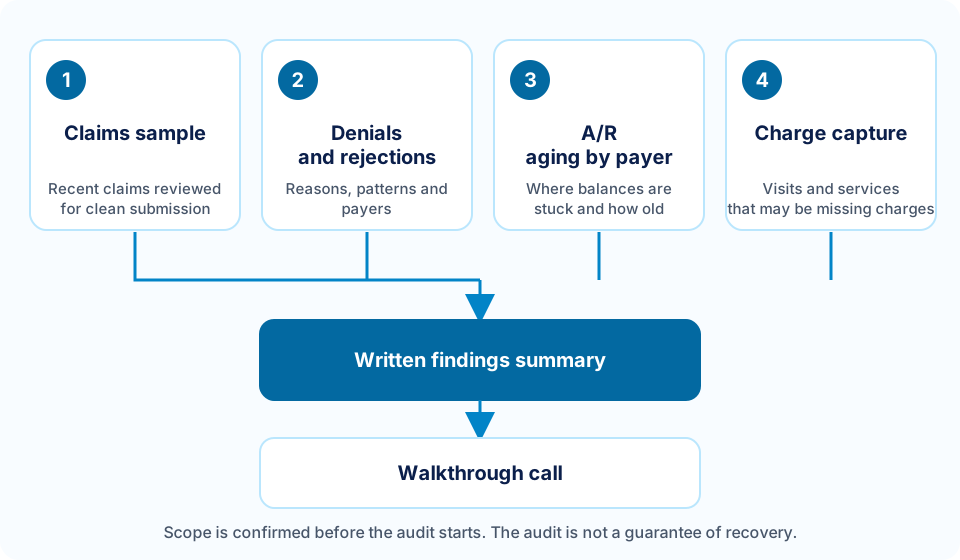
The audit has four review areas. Each one comes from data your practice already has.
| Review area | What we look at | What it can show |
|---|---|---|
| Sample of recent claims | A de-identified sample, or a sample reviewed through a secure portal, covering claim data, codes, modifiers, and payer responses | Recurring claim errors, coding and modifier patterns, rejected or delayed claims |
| Denial and rejection reasons | Denial and remittance reports, grouped by reason code, payer, and service | Which denials are most common, which payers drive them, and which look preventable |
| A/R aging by payer | Open balances grouped by age and by payer | Where balances are stuck, which payers are slow, and which old claims may still be workable |
| Charge capture gaps | Comparison of scheduled or documented visits to billed charges, where data allows | Services delivered but not billed, late charges, missing add-on services |
Sample of recent claims
We look at a recent set of claims to see how they were built and what came back. For each claim we check whether the procedure and diagnosis codes agree, whether modifiers are used consistently, whether the rendering and billing provider details look right, and how the payer responded. Patterns matter more than single claims. One bad modifier is a one-off. The same modifier error across 40 claims is a process problem.
We do not copy proprietary code descriptions into our findings, and we do not make clinical judgments about whether a service was appropriate. Coding observations are about whether the claim data is internally consistent and aligned with the payer’s published rules.
Denial and rejection reasons
Rejections and denials are different. A rejection usually means a claim did not pass front-end edits and never entered adjudication, so it can be corrected and resubmitted. A denial means the payer processed the claim and decided not to pay it, at least in part. We group both by reason so you can see what to fix upstream. If you want to learn the common reasons first, read why medical claims are denied. Where a pattern is clear, the next step is usually denial management.
A/R aging by payer
The A/R aging report shows how long balances have been open. We sort by payer and by age bucket to see which payers hold the oldest balances, and whether the old balances are mostly payer-owed claims or patient-responsibility amounts. We also look for claims that appear to have stopped moving, with no recent payer contact. Timely filing and appeal windows differ by payer and contract, so we flag old claims for review against each payer’s current policy and never assume a single deadline. Where a pattern appears, A/R recovery and follow-up is the related service.
Charge capture gaps
Charge capture is where services get turned into billable charges. Gaps occur when a visit is documented but no charge is created, when add-on services are left off, or when charges reach the biller days or weeks late. The sample we review may allow only a partial check, depending on what data you can export. When a full comparison is not possible, we say so in the findings and describe what additional data would be needed.
What the practice receives
- A written findings summary. A document that lays out what we reviewed, what we found, and what we could not assess because of the data provided.
- A walkthrough call. A live conversation to explain the findings, answer questions, and talk through what to address first.
- No obligation. The audit does not commit your practice to any service. You can use the findings with your own staff, another vendor, or with us.
The findings summary is organized by area: claims, denials, A/R, and charge capture. For each finding we describe what the data shows, the likely cause, and a suggested next step. Findings are observations from the sample and the reports you supplied. They are not a measurement of every claim your practice has ever submitted, and they are not a prediction of future results.
The audit identifies patterns and possible causes in the data you provide. It cannot tell you how much you will collect, and it does not promise recovery of any specific amount. Payers decide whether to pay, and claim eligibility for payment depends on the plan, the contract, and the facts of each case.
This is an illustration with round numbers and no real patient data. A small practice exports a denial report and an A/R aging report. The denial report shows that a large share of denials from one payer carry the same reason: the rendering provider is not on file. The aging report shows many of that payer’s claims in the oldest bucket. Together they point to a provider enrollment problem and not a coding problem. The suggested next step is to confirm enrollment status with the payer before any appeals, which is why audits compare reports side by side.
What is needed to start
You do not need to prepare a large package. The audit starts with report exports from your practice management or billing system. Request these where available:
- A/R aging report by payer, showing balances in standard age buckets.
- Denial or remittance report for a recent period, ideally with denial reason or adjustment codes, payer, and service date.
- Payer list showing the plans you bill and rough share of your claims.
- Claim sample of recent claims, provided either as a de-identified export or through a secure portal we set up with you.
- Basic practice details such as specialty, number of billing providers, billing system, and whether billing is done in-house or by a vendor.
- Context about what concerns you most, such as rising denials, slow payments, or a recent change in staff or software.
The reports do not need to be polished. If a report is not available, tell us and we will work with what you have. If your system has a different report name, we can help find the equivalent.
Protected health information and privacy
Do not send patient records through the website form. The request form collects practice contact details and a short description of your needs, and nothing else. If the audit needs protected health information, we use a secure workflow under a signed business associate agreement before any such data is shared. When possible, we prefer de-identified exports so the audit can begin sooner and with less risk. How de-identification is handled in your system is up to your practice, and we can describe what to remove.
How the audit works, step by step
- Request. You send a request through the form on this page or the contact page.
- Scope conversation. We confirm your specialty, billing setup, and what you want to learn. We confirm what data you can export and how it will be shared.
- Data handoff. You send the report exports and claim sample through the agreed secure method. If protected health information is involved, the business associate agreement is signed first.
- Review. We review the four areas and prepare the findings summary.
- Walkthrough. We hold the call, answer questions, and agree on what to prioritize.
- Decide. You decide what to do with the findings. There is no obligation to continue with Mednex Group.
The time needed depends on how quickly the data arrives, how complete it is, and the size of the practice. We confirm the expected timing with you when we agree on scope and do not quote a fixed number here.
How we check findings
Findings are only useful if they are accurate, so we apply a few checks before anything goes into the summary:
- Reconcile totals. Report totals are compared across the reports you supplied, and differences are noted.
- Look for patterns, not anecdotes. A finding needs to appear in more than a single claim to be listed as a pattern.
- Separate cause from symptom. A denial reason is a symptom. The cause may be front-end data entry, enrollment, coding, or documentation.
- Verify payer rules. Where a finding depends on a payer rule, we check the payer’s current published policy. If we cannot confirm a rule, the summary says so and recommends checking the payer’s current policy.
- State limits. Every finding notes what data it is based on.
Common findings the audit may surface
These are categories we look for. They are not predictions about your practice.
| Possible finding | Typical sign in the data | Where it is usually fixed |
|---|---|---|
| Eligibility or coverage errors | Denials for inactive coverage or non-covered services | Front desk, eligibility and benefits verification |
| Missing authorization | Denials citing no authorization on file | Scheduling and prior authorization |
| Provider not enrolled | Denials for rendering provider not on file, concentrated in one payer | Credentialing and enrollment |
| Coding or modifier inconsistency | Repeated edits or denials on the same procedure | Coding review and provider education |
| Late claim submission | Large gap between service date and submission date | Charge entry and billing workflow |
| Stalled A/R | Claims in the oldest bucket with no recent payer contact | A/R follow-up workflow |
| Underpayment | Payments below the expected contract rate, when the rate is known | Payment posting and payer review |
| Charge capture gaps | Documented visits without matching charges | Charge capture and documentation handoff |
What is out of scope
The audit is limited on purpose. It does not include:
- Legal review. We do not give legal advice or review contracts for legal sufficiency. Questions about compliance liability belong with a qualified attorney.
- Payer contract negotiation. We can note where payments appear to differ from a rate you tell us about, but we do not negotiate with payers on your behalf as part of the audit.
- Clinical documentation judgments. We do not decide whether care was medically necessary or whether a clinician’s documentation is clinically adequate. Those decisions belong to your providers.
- Recovery promises. We cannot promise that any claim will be paid, appealed successfully, or recovered. Payers decide.
- Government or payer audit defense. The audit does not represent you in a payer audit, a recoupment request, or a government review.
- A full compliance audit. It is a billing performance review based on a sample, not a certification that your billing is compliant.
What happens after the audit
The findings belong to you. Some practices fix the issues internally, such as updating a front-desk checklist or correcting a charge entry rule. Others choose help with a specific area. Depending on what the audit shows, the options may include:
- Medical billing services for claim submission and payment posting.
- Denial management to work current denials and trace causes.
- A/R recovery for older unpaid claims.
- Prior authorization and credentialing if the findings point to front-end gaps.
Scope and pricing for any ongoing service are discussed separately, and we do not assume you will continue after the audit.
How to request the audit
Requesting the audit takes a few minutes.
- Use the request form on this page to share your practice name, specialty, a contact person, and a short note on what you want reviewed. You can also reach us through the contact page.
- Do not enter patient names, identifiers, or any health information in the form.
- We will respond to arrange the scope conversation and agree on a secure way to share the report exports.
If you prefer to talk first, you can reach Mednex Group by phone or email from the contact page. For more about how the company works, see the about page.
Frequently asked questions
What is a medical billing audit?
It is a structured review of how claims move from a delivered service to payment. It checks claim accuracy, denial and rejection reasons, A/R aging, and charge capture to find where revenue or time is lost and what is likely causing it. It is a billing performance review, not a compliance certification.
Is the audit really free?
Yes, it is a no-obligation review. You receive a written findings summary and a walkthrough call, and you are free to use the findings with your own staff, another vendor, or with Mednex Group. Any ongoing service is scoped and priced separately and is never assumed.
What do I need to provide?
Report exports from your billing system: an A/R aging report, a denial or remittance report, and a payer list. We also review a claim sample, either de-identified or through a secure portal. Tell us your specialty, billing setup, and main concerns. The reports do not need to be polished.
Do I send patient records through the form?
No. The request form collects practice contact details and a short note only, never patient names or health information. If protected health information is needed, we use a secure workflow under a signed business associate agreement. De-identified exports are preferred where possible.
How long does the audit take?
It depends on how quickly the data arrives, how complete it is, and the size of the practice. We confirm the expected timing during the scope conversation and do not promise a fixed number of days here, because the data you can export sets the pace.
Which practices is the audit for?
It is for practices that bill US payers, including commercial plans, Medicare, and Medicaid. It fits practices with frequent denials, aging A/R, a pending billing change, or a suspicion that charges are being missed. It adapts to medical, dental, and behavioral health claim forms and code sets.
Will the audit tell me how much I can recover?
No. It identifies patterns and likely causes in the data you provide. It cannot promise recovery of any amount, because payers decide whether to pay, and eligibility depends on the plan, the contract, and the facts of each claim. Treat the findings as a map of where to look.
What is not included?
Legal review, payer contract negotiation, clinical documentation judgments, defense in payer or government audits, and any promise of recovery are outside the audit. It is also not a full compliance audit. Questions in those areas belong with a qualified attorney or compliance professional.
What happens after the audit?
You get the findings and decide what to do. Some practices fix issues internally. Others ask for help with billing, denial management, A/R recovery, prior authorization, or credentialing. There is no obligation to continue with Mednex Group, and scope and pricing for any service are discussed separately.